Some links on this page are affiliate links. If you click through and make a purchase, we may earn a small commission at no extra cost to you. This helps us maintain and improve this independent guide. Learn more.
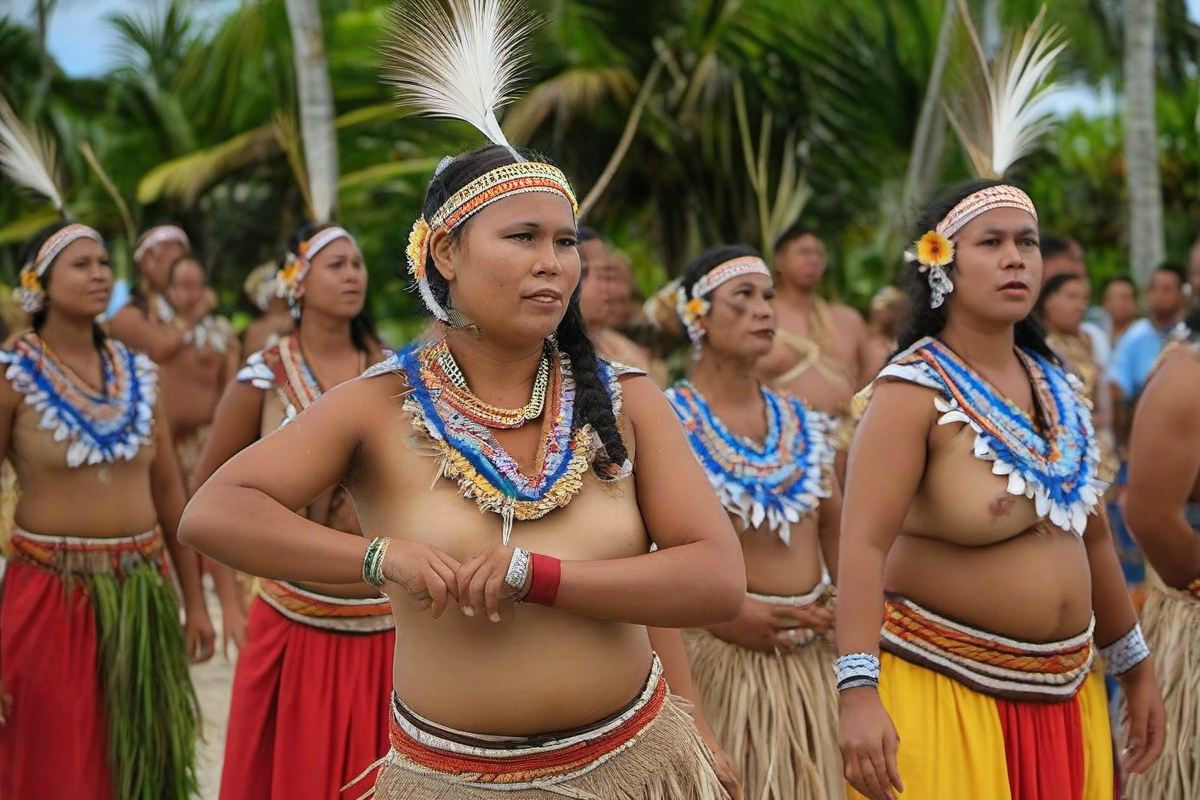
For over 3,000 years, the people of Nauru have cultivated a culture as rich and resilient as the Pacific Ocean that surrounds their tiny island. Rooted in deep respect for the land and sea, animated by music and movement, and held together by the strength of family and community, Nauruan culture is a living, breathing tapestry that continues to evolve while honouring its ancient foundations. From the rhythmic sway of traditional dance to the bold flavours of island cooking, every aspect of life on Nauru tells a story of identity, survival, and pride that is unique among Pacific island nations.
🕺 Dance & Music
Dance on Nauru is far more than entertainment — it is a living archive of memory, a language of the body that preserves the stories of ancestors, the rhythms of the ocean, and the cycles of island life. Traditional Nauruan dance is characterised by precise, flowing hip movements, synchronised hand gestures that mimic the sway of palm fronds and the motion of waves, and elaborate costumes woven from pandanus leaves, coconut fibres, and bird feathers. Every performance is a visual poem — a connection to the past performed in the present for future generations.
The Ekorere — A Seated Story
The most iconic traditional dance form is the ekorere, a seated dance performed by women using only the upper body, arms, and hands. Dancers sit in a row, their legs folded beneath them, their bodies perfectly still from the waist down, while their hands trace intricate patterns in the air — telling tales of ocean voyages, the ripening of breadfruit on the tree, the flight of the frigate bird, the catch of a prized tuna, or the birth of a child into the community. The discipline required is extraordinary: every finger position, every tilt of the head, every glance carries specific meaning that is understood by those who know the tradition. The ekorere is performed at major celebrations, welcoming ceremonies for distinguished visitors, cultural festivals, and national holidays. It remains one of the most treasured and recognisable expressions of Nauruan identity, taught to young girls by their mothers and grandmothers.
The Eibobo and War Dances
In addition to the ekorere, traditional Nauruan dance includes the eibobo — a standing dance performed by both men and women that incorporates more vigorous full-body movements, footwork, and narrative gestures. Historically, war dances (similar to the Māori haka in spirit) were performed by men before battle to intimidate opponents and invoke ancestral protection. These dances featured powerful stomping, rhythmic chest-slapping, fierce facial expressions, and warrior chants. While the original war dances are no longer performed as military rituals, their influence can be seen in contemporary dance performances during national celebrations.
Rhythms of the Island
Music in traditional Nauruan life was built around percussion and voice. The body of the dance drum (a carved wooden drum played with the hands) and bamboo stamping tubes (hollow bamboo lengths struck against the ground in unison) provided the heartbeat for dance and ceremony. Conch shells were used as trumpets for signalling across the island. Singing accompanied every important event — harvest chants celebrating the breadfruit and coconut seasons, ocean-faring songs sung by fishermen heading out to sea, lullabies passed from mother to child, and funeral dirges honouring the departed — with complex harmonies passed orally across generations without any written musical notation.
Today, Nauruan music has blossomed into a vibrant fusion that bridges tradition and modernity. While traditional chants and drumming are still performed and actively taught in schools, contemporary Nauruan artists blend ancestral rhythms with Pacific reggae, pop, gospel, and island-style rock. Church choirs hold an especially revered place in musical life: four-part harmonies sung with passion, precision, and remarkable vocal power fill the island's churches every Sunday, and choral competitions during national celebrations draw enormous crowds from all eight districts. The annual choral competition during Angam Day, where churches compete for the President's trophy, is one of the most anticipated musical events of the year.
🍛 Island Flavors
Nauruan cuisine is a love letter to the Pacific — honest, bold, and deeply connected to what the ocean and the land provide. There are no elaborate sauces or imported pretensions here; the flavours come from the quality of the ingredients themselves: fish pulled from the reef that morning, coconuts plucked from the palm, breadfruit roasted over an open fire until the skin blackens and the flesh turns soft and sweet. To eat on Nauru is to taste the island itself — its waters, its soil, its sun.
From the Sea
Fish is the heart of the Nauruan table. Tuna (particularly skipjack and yellowfin), mahi-mahi, snapper, grouper, and a variety of colourful reef fish are prepared in a variety of traditional ways — grilled over hot coals and brushed with coconut oil, fried to golden crispness, or served raw in a vibrant coconut-lime marinade that is the island's answer to ceviche. The dish known simply as coconut fish — fresh raw fish (usually tuna) steeped in fresh lime juice and rich coconut cream, often served with crispy breadfruit chips or freshly grated coconut — is a national treasure. Another favourite is ika mata, the Nauruan version of the classic Pacific raw fish salad, featuring fish marinated in citrus and mixed with coconut cream, chilli, and vegetables.
From the Land
Breadfruit is the staple carbohydrate of the Nauruan diet, appearing in countless forms: roasted whole in an underground oven (umu), sliced and fried into chips, boiled and mashed with coconut cream into a pudding-like dish, or fermented in leaf-lined underground pits to preserve it for leaner months. Pandanus fruit, with its distinctive sweet-tart flavour and bright orange-red colour, is eaten fresh, juiced, or dried into chewy strips that can be stored for months. Local bananas — smaller, sweeter, and more flavourful than the commercial Cavendish variety found in supermarkets worldwide — are roasted on the fire or simmered in coconut milk with a pinch of salt for a simple, soulful dessert. Taro and giant swamp taro are also grown in limited quantities, particularly around the fertile areas of Buada Lagoon.
The Communal Table
Eating on Nauru is never a solitary affair. Meals are laid out on banana or pandanus leaves spread across the floor of the family home or on woven mats in the community meeting house, with everyone gathering around to share. Extended family, neighbours, and visitors are always welcomed — the concept of eating alone is almost culturally unheard of. Special occasion feasts feature an extraordinary abundance of dishes: grilled reef fish, rich coconut curries, roasted pork (a delicacy reserved for celebrations), taro, breadfruit in multiple preparations, and the ever-present bowl of freshly grated coconut for sprinkling over everything. The communal meal is one of the most cherished and enduring expressions of Nauruan hospitality — a practice that strengthens social bonds and reinforces the value of 'engam' (mutual support and sharing).
🎉 Celebrations
Nauru knows how to celebrate. Despite its tiny size and small population, the island observes a full and vibrant calendar of national holidays, cultural festivals, religious observances, and community gatherings — each one an explosion of colour, music, food, dance, and togetherness that brings the entire island together.
Angam Day — Survival and Resilience
Angam Day (26 October) is Nauru's most profound and emotionally significant national observance. The word angam means 'to celebrate survival' or 'to reach home' in the Nauruan language. The day commemorates two critical moments in the nation's history: in 1932, when the Nauruan population recovered to 1,500 (the minimum deemed necessary for survival as a genetically viable community) after the devastating Spanish flu epidemic of 1920 killed approximately 200 people, and again in 1949, when the population crossed that same threshold once more following the trauma of World War II and the forced deportation of Nauruans to Truk (Chuuk), where 500 of the 1,200 deportees died from starvation and disease. The day is marked by traditional dance competitions between districts, powerful choral contests for the President's trophy, sporting events, naming ceremonies for 'Angam babies', community feasts, and the lighting of ceremonial fires around the island. It is a day of deep reflection, pride, gratitude, and celebration of Nauruan identity.
Constitution & Independence Days
Constitution Day (17 May) celebrates the adoption of Nauru's constitution in 1968, which established the parliamentary system of government. The festivities stretch over a full week and include parades through the streets of Yaren and Aiwo, live concerts featuring local musicians and visiting Pacific artists, traditional craft and weaving exhibitions, the Miss Nauru pageant, community sports tournaments, and an abundance of food stalls serving everything from grilled reef fish to coconut desserts. Independence Day (31 January) marks Nauru's emergence as a sovereign republic in 1968 — the world's smallest independent republic — with a formal flag-raising ceremony at dawn, the President's nationally broadcast address, speeches by community leaders, traditional dance performances, and a day of sports, games, family gatherings, and evening fireworks.
Faith and Festivity
Christmas and Easter are widely and joyfully celebrated across the island, with Nauruan-language carols (featuring distinctive harmonies and island rhythms that blend Micronesian musical traditions with Christian hymnody) sung in churches and homes. Gospel Day commemorates the arrival of Christianity to Nauru. National Youth Day brings together young Nauruans for sports tournaments, talent shows, leadership workshops, and career fairs focused on building the next generation of leaders. Each of Nauru's eight districts — Aiwo, Anabar, Anetan, Anibare, Baitsi, Boe, Buada, and Yaren — also holds its own annual district day, with feasting, dancing, and games that reinforce local identities and the friendly rivalries that add colour to island life.
🎨 Handicrafts & Art
Nauruan craftsmanship is a testament to human resourcefulness and the pursuit of beauty from limited natural materials. For centuries, islanders have transformed the materials of their environment — pandanus leaves, coconut husks and fibres, shells, wood, coral limestone, and stone — into objects of extraordinary utility, beauty, and cultural significance. While the phosphate boom of the 20th century saw a significant decline in many traditional crafts as imported goods became widely available, recent decades have witnessed a powerful cultural renaissance, with new generations eagerly learning the skills and techniques of their grandparents.
The Art of Weaving
Nauruan women are among the finest weavers in the Pacific region. Using pandanus leaves — harvested from the coastal fringe, dried thoroughly in the tropical sun, split into fine, uniform strips, and dyed using natural pigments derived from roots, leaves, barks, and mineral soils — they create an extraordinary range of items: sturdy baskets for carrying fish and produce, intricately patterned floor mats for sitting and sleeping, wide-brimmed hats for protection from the intense equatorial sun, elegant hand fans, and the iconic pandanus bags that are both practical and beautiful. The geometric patterns woven into each piece — chevrons, zigzags, diamonds, and concentric shapes — are not merely decorative; they carry specific symbolic meaning, representing ocean waves, fish scales, turtle shells, the flight paths of seabirds, and the stars used for navigation. A finely woven pandanus mat is considered a treasured family heirloom, passed from mother to daughter across many generations.
Wood, Shell & Stone
Men traditionally worked with wood and coconut shell, carving bowls for serving food, tools for daily use, weapons for hunting and defence, and ceremonial items for rituals and dances. The frigate bird — Nauru's beloved national symbol, featured on the national coat of arms — appears constantly in carved wooden pieces, from jewellery pendants and hair combs to the decorative prows of ceremonial canoes. Shell necklaces, bracelets, and armbands, made from cowrie, cone, pearl, and other marine shells, remain popular adornments for both everyday wear and special occasions such as dances and festivals. These crafts are not just art — they are tangible connections to Nauruan heritage and identity.
A Living Renaissance
In recent years, community-led workshops, school cultural programmes, and cultural festivals have breathed new life into Nauruan handicrafts. The Nauru Museum in Yaren houses and displays the finest examples of traditional and contemporary craftsmanship, serving as both a cultural repository and an educational centre for young Nauruans. Local artisans sell their work at markets, cultural events, and directly to visitors. Purchasing authentic handmade items — every basket, every carved pendant, every woven fan — directly supports the preservation of Nauruan cultural heritage and provides meaningful economic opportunity for skilled artisans.
🤝 Community Life
If there is one word that defines Nauruan society, it is connection. Family, village, church, tribe, and district weave together into a social fabric so tightly knit that the concept of an isolated individual living independently is almost unimaginable. On an island of just 21 km², where everyone knows everyone — and often knows their family history going back generations — that proximity has forged a culture of extraordinary warmth, mutual responsibility, generosity, and collective resilience that visitors consistently remark upon.
Family and the Twelve Tribes
The extended family is the fundamental unit of Nauruan social life. Relatives span far beyond the nuclear family, encompassing grandparents, cousins, aunts, uncles, nieces, nephews, and sometimes even more distant kin, who all share in raising children, making important family decisions, pooling resources, and supporting one another through life's challenges and celebrations. Historically, Nauruan society was organised around 12 traditional tribes — including the Deiboe, Eamwit, Eamwidamit, Emea, Eano, Irutsi, Iruwa, Iwi, and others — each with its own clearly defined territory, lineage, customs, and recognised chief. While the tribal system no longer holds formal governance authority in Nauru's modern democratic system, tribal identity remains a powerful source of pride, belonging, and continuity, and many families still trace their lineage to a specific ancestral tribe.
Engam — The Spirit of Mutual Support
The Nauruan concept of engam — roughly translating to mutual support, sharing, generosity, and looking after one another without expectation of direct repayment — is the ethical backbone of the community and the most deeply held Nauruan value. When a family builds a new house, the entire neighbourhood shows up to help with construction, food preparation, and childcare. When there is a wedding, a funeral, a birth, or a celebration, everyone contributes food, money, labour, and time without being asked. This spirit of collective responsibility extends to visitors and strangers, who are often astonished by the generosity, openness, and warmth they encounter. Engam is not a formal rule or a written code — it is simply how life on Nauru has always worked, and how it continues to work today.
Faith and the Rhythm of the Week
Christianity — predominantly the Nauru Congregational Church (Protestant) and the Roman Catholic Church — is absolutely central to daily life and community identity. Sunday on Nauru is a sacred day of rest and worship; the island virtually shuts down, with almost the entire population attending church services dressed in their finest white clothing — white symbolising purity and respect. Four-part harmonies fill the sanctuaries with extraordinary power and beauty, and the sermon is followed by shared meals, family visits, and quiet community time. Church is not merely a place of worship on Nauru — it is the social and spiritual hub of each community, where announcements are made, friendships are strengthened and renewed, the week's news is exchanged, and the bonds of community are reinforced week after week.
Sports and Community Pride
Nauruans are passionate about sports, and athletic competition is a major pillar of community life and pride. Australian rules football is the most popular team sport, with local clubs and district teams drawing enthusiastic crowds for matches played on the island's sports fields. But Nauru's greatest sporting pride and international recognition comes from weightlifting — the island has produced world-class lifters who have brought home medals from the Commonwealth Games and even represented Nauru at the Olympic Games. Weightlifting is a source of immense national pride, demonstrating to the world that even the smallest republic can produce champions of the highest calibre. Sporting events of any kind are fundamentally community affairs: families set up picnics on the sidelines, children play and run around, and the entire district turns out to cheer for their representatives in an atmosphere of joy, pride, and friendly competition.
🌟 Did You Know?
Nauru has the highest rate of obesity in the world — a complex legacy of the phosphate boom era when imported processed foods (particularly refined flour, sugar, and fatty meats) rapidly replaced the traditional diet of fresh fish, coconut, breadfruit, pandanus, and locally grown produce. However, this statistic tells only part of the story: the island is also home to Olympic-calibre weightlifters who have won medals for Nauru at the Commonwealth Games, proving that beneath the health statistics beats the heart of a determined, athletic, and resilient nation. Nauru also holds the remarkable distinction of being the only country in the world without a designated capital city — Yaren serves as the de facto administrative centre, hosting the Parliament House, government offices, the international airport, and most foreign embassies, but it holds no official legal status as a capital. Nauru is also the world's smallest republic and the second-least populous country after Vatican City.
Cultural Etiquette for Visitors
Visitors to Nauru should be aware of a few important cultural norms. Dress modestly, particularly when visiting villages or attending church services — shoulders and knees should be covered. Always ask permission before taking photographs of people, especially elders. Remove your shoes before entering someone's home. Accept food and drink when offered — refusing hospitality can be considered impolite. Sunday is a day of rest and worship, so avoid noisy activities, and respect church services. Greet people with a smile and a friendly 'Ekamawir oma' (good morning) — Nauruans are warm and welcoming, and any effort to speak the Nauruan language will be genuinely appreciated.
Nauruan culture is not a museum piece preserved behind glass — it is alive, evolving, adaptable, and deeply felt by every person who calls this tiny island home. Whether through the hypnotic rhythm of the ekorere, the shared meal on pandanus leaves under a thatched roof, the roar of the crowd at a weightlifting competition, the soaring harmonies of a Sunday church choir, or the quiet laughter of children playing on a reef-fringed beach, the spirit of Nauru is unmistakable. It is the spirit of a small island with an enormous heart — resilient, generous, creative, proud of its past, and hopeful for its future.